November is celebrated as Native American Heritage Month. The Berkeley County Museum is proud to work with the Wassamasaw Tribe of Varnertown Indians and other indigenous communities in the state.
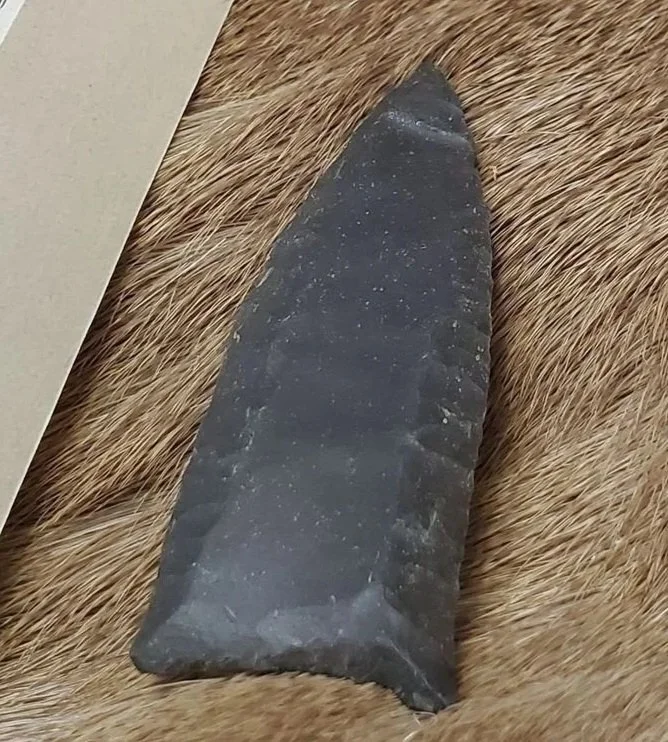
92.6.2
The first human settlement of South Carolina came about 13,000 years ago, during a time now called the Paleoindian Period. The Huggins Tract, located near Daniel Island, is one archaeological site with evidence of Paleoindian presence. The Redstone fluted point shown here (and on display in the Museum!) was found in an undisclosed location in coastal South Carolina and dates from about 12,000 years ago.
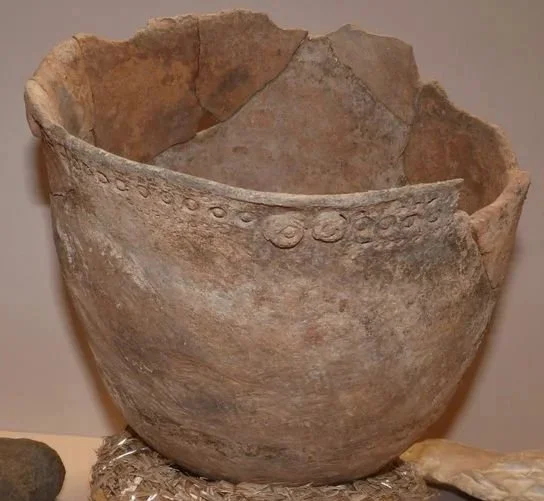
95.2.1
After the Paleoindian Period came the Archaic Period (8,000 to 3,000 BC), the Woodland Period (3,000 BC to 1000 AD), and the Mississippian Period (1000 to 1520 AD). The Keller Site, outside of St. Stephen, holds evidence of both Woodland and Mississippian presence, including potential long-term habitation; the site was added to the National Register in 1980.
The pot on the right (also on display in the Museum) likely dates to the Woodland or Mississippian Period. It was found in 1978 near the Diversion Canal, on the muddy shore of Lake Marion. It was originally found in sixteen pieces; an archaeologist reassembled it sometime before it was donated to the Museum in 1995.
Berkeley County is located on the traditional and ancestral lands of several Indigenous groups, including the Santee, Etiwan, Wando, and Seewee. Some 20th-century and modern sources group these and other early Lowcountry peoples under the label “Cusabo,” though it is unlikely they were part of an overarching collective group.
By the early 1700s, white colonists were increasing referring to their Indigenous neighbors as “settlement Indians.” Native Americans from various Lowcountry and regional nations joined together for safety as their numbers dwindled, living in the shadow of European settlements. Some of these groups went willingly, while others were forcibly moved. The group of “settlement Indians” near modern-day Carnes Crossroads eventually became known as the Summerville Indians and, later, the Varnertown Indians.
The name ‘Wassamasaw Tribe of Varnertown Indians’ was officially adopted by the tribe in the early 2000s. The name recognizes both the Etiwan ancestors who moved into Wassamasaw Swamp and the various Native nations that blended to create the tribe as it exists today. For more information about the Wassamasaw, visit their website.