
Thomas Walter was likely born in Hampshire, England about 1740; an aunt died there in 1784 and left him a house, from which he collected rent for the last 6 years of his life. It does not appear that he attended a major university like Cambridge or Oxford, but Walter likely received a formal education. By 1769, Walter was in South Carolina.
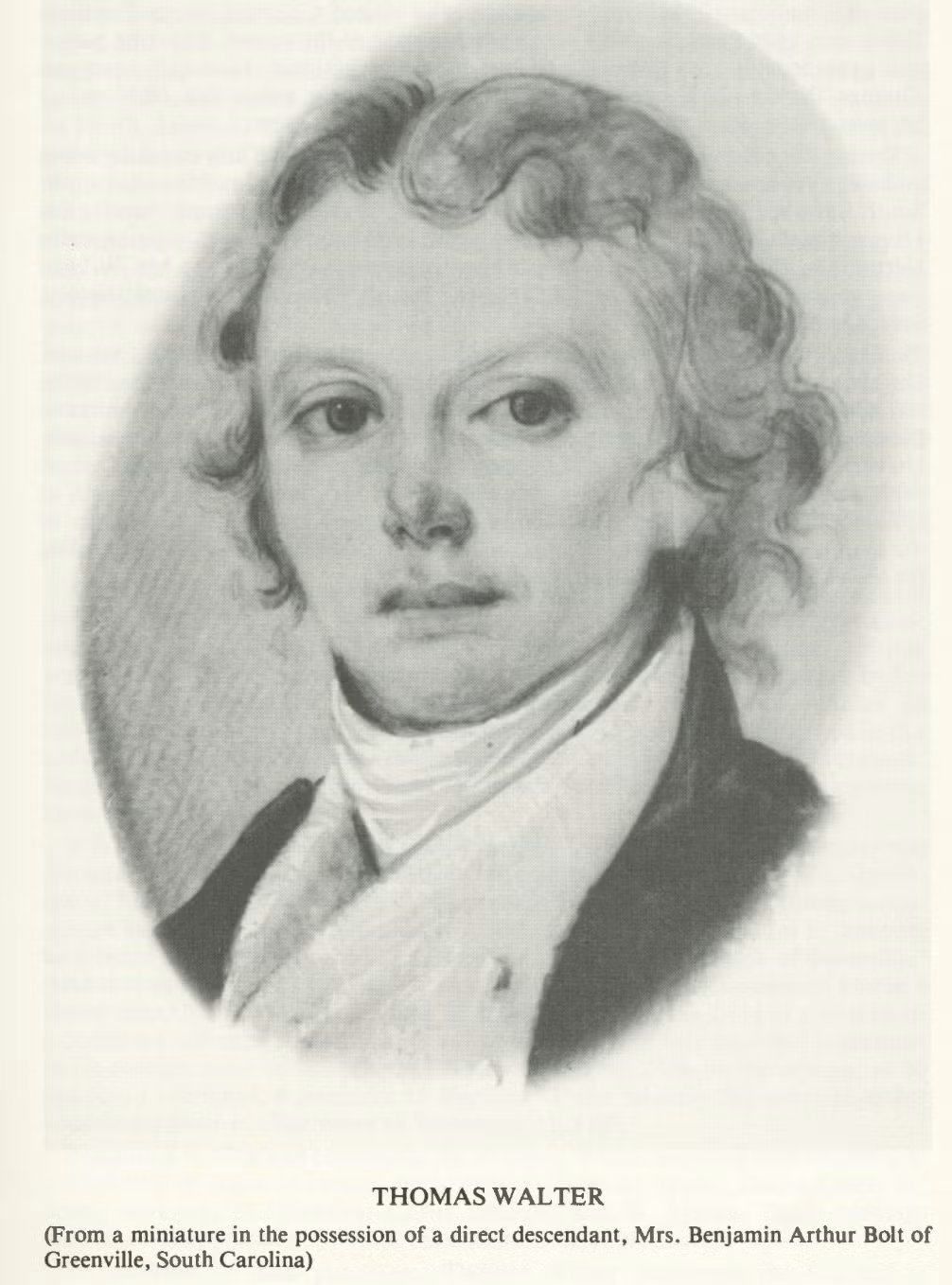
Over the next two decades, Walter acquired nearly 5,000 acres of land across the Lowcountry and Pee Dee, much of which was in Berkeley County. Though he spent time in Charleston, his home plantation was on the south side of the Santee River near Mexico Plantation and the Marion family.
Walter’s first wife was Anne Lesesne of Daniel Island, who unfortunately died within a year of marriage. Walter’s next wife was Ann Peyre, possibly of St. Stephen’s Parish, with whom he had four children; their marriage was also short, ending with Ann’s death in 1780. His third and final marriage, in 1781, was to Dorothy Cooper. They also had a daughter.
Around the time of Anne’s death, Walter began an earnest study of botany. Walter studied the plants within an approximately fifty-mile radius of his plantation and worked with fellow botanist John Fraser to study and collect specimens from the Midlands and Upstate. Walter’s botanical garden on the Santee was likely one of the first intentional botanical gardens in the English colonies of North America. Fraser took Walter’s research manuscript and samples from his collection to England in 1788. The manuscript was published as Flora Caroliniana, and the specimens are still housed at the British Museum of Natural History. Walter was the first to use the Linnaean system of classification for North American flora, providing brief descriptions for over 1,000 plant species. Since his death, eight plant species have been named in Walters’ honor. The Flora Caroliniana can be viewed as a PDF here.
Being an Englishman by birth, many assume that Walter was a Loyalist during the Revolutionary War. This was not the case. Walter was a member of the committee for the Continental Association, actively recruiting for the Patriot cause by at least the autumn of 1774. In 1779, the botanist-planter was commissioned Deputy Paymaster of the Militia.
Walter also had an even more local connection to us here at the Berkeley County Museum, which is located inside Old Santee Canal Park. In 1786, Walter joined the board of a commission created to investigate and plan connecting the Santee and Cooper Rivers with a canal. The Canal would not be constructed until after Walter’s death, but he was involved in the early years of planning.
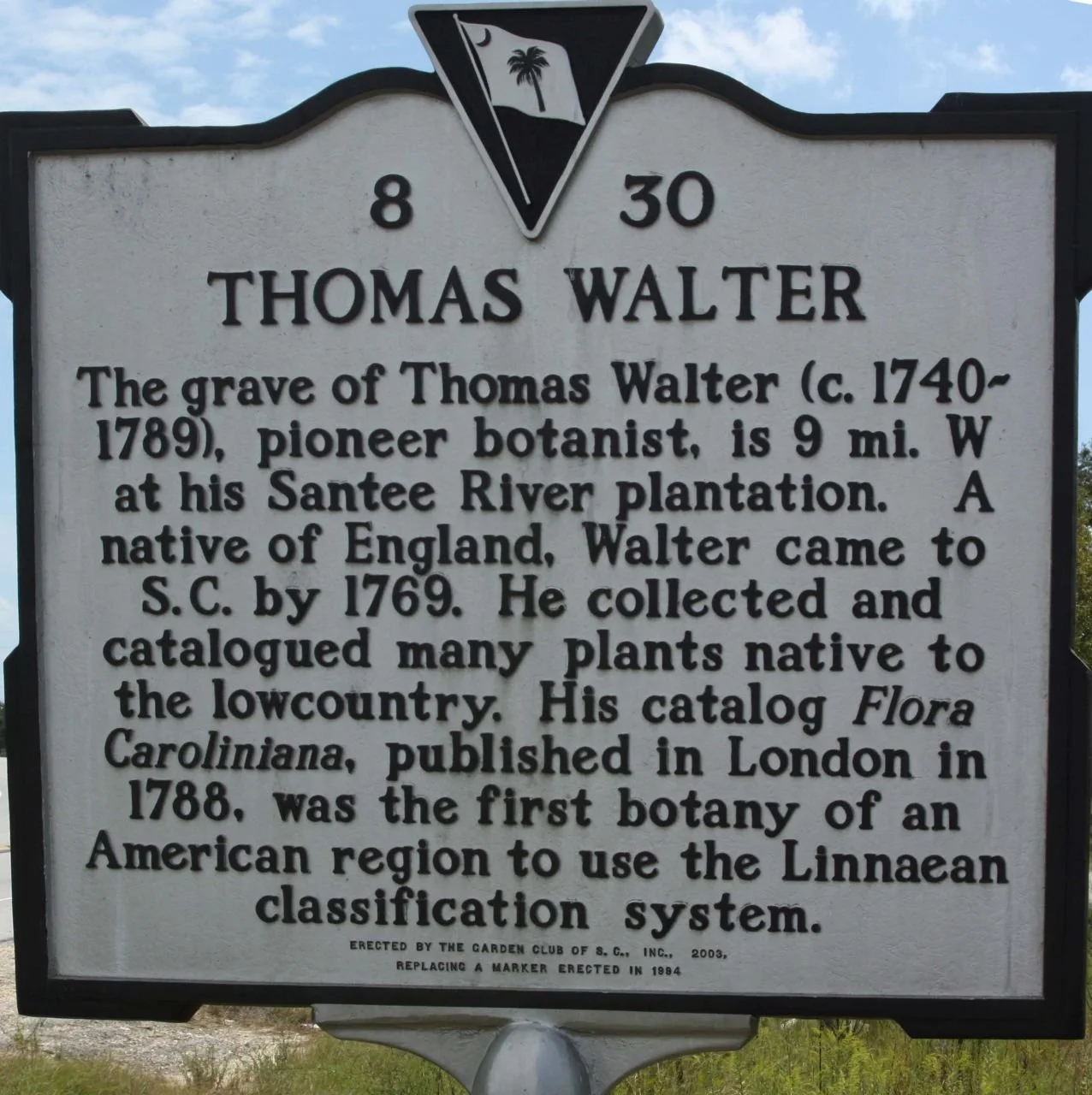
Photo by Mike Stroud, 2009.
Thomas Walter died in January 1789 after being ill for some time. His will listed 32 enslaved people, 7 oxen, 9 cows, 39 sheep, 19 hogs, 230 bushels of corn, 45 barrels of rice, and nearly 3000 bushels of rough rice. He was buried in his garden beside the Santee River. A historical marker for him stands outside of St. Stephen, and a road called Thomas Walter Circle can be found in Santee. Botanist H.W. Ravenel visited the Walter property in the 1850s, but unfortunately, "one or two . . . things, were the only memorials left of his botanical garden.”