
June 15 is celebrated as National Prune Day. For more information, visit the California Prune website.
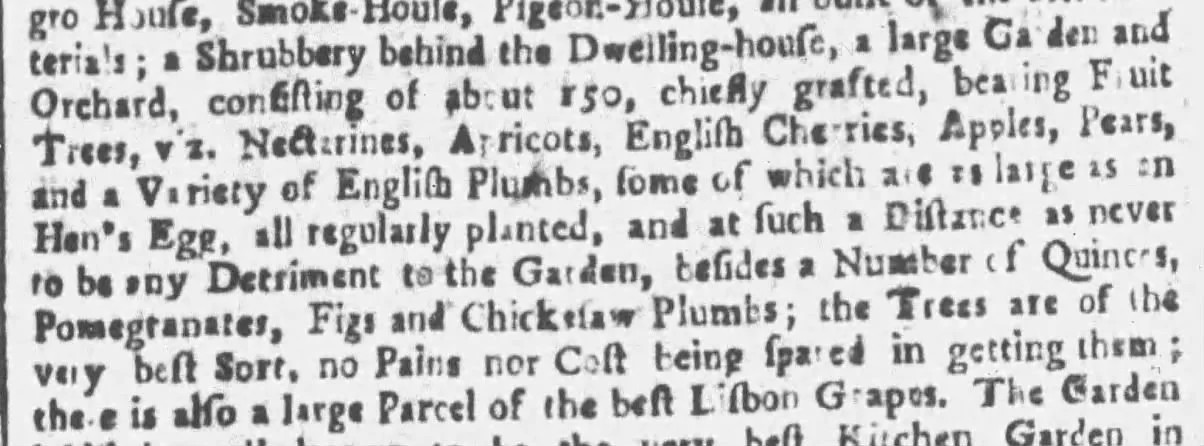
The South-Carolina and American General Gazette, Mar 13, 1777.
There are over a dozen varieties of plums native to North America. Early colonists would have had access to the wild American plum, Prunus americana, here in South Carolina. Prunus angustifolia, the Chickasaw plum, is native to the continent, but was likely introduced to South Carolina via Native American trade. Notice in the 1777 property ad that the orchard contains plum trees of both English and Chickasaw varieties. Henry Laurens also introduced French plum trees into the Lowcountry. As early as 1739, traders in Charleston were importing “Raisins of the Sun and Prunes” for the colonists’ enjoyment. (An interesting, non-prune-related note: importer William Welfit noted in the same July 1739 notice that he would take payment in “Good Rice, Pich (sic.), Tar and Deer Skins” in addition to “ready Money.”)
Horticultural experimentation with native plums occurred throughout the following centuries, but most larger cities and markets relied on important or non-native plums for their money-making. Not all plums are good for making prunes; both the wild American plum and the Chickasaw plum can be dried to eat, but other varieties are better for this purpose. Today, prunes most commonly come from the European plum.
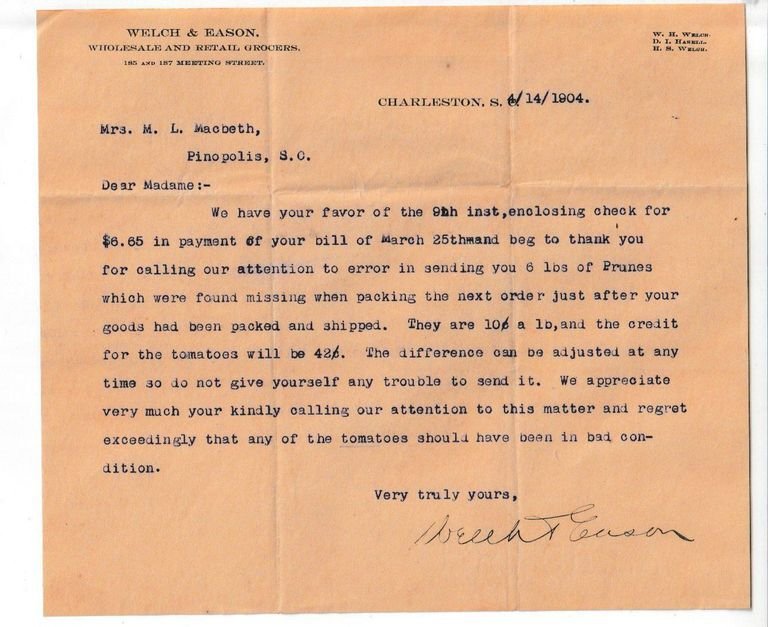
MSS02.2.31
In the spring of 1904, Mrs. Mary Louise (Gaillard) Macbeth of Pinopolis ordered groceries from Welch & Eason in Charleston. She was accidentally sent six pounds of prunes! We don’t know if Mrs. Macbeth settled up with the grocers, but we do have several other receipts from the Macbeth family around the turn of the 20th century.