Tony Small was a Black man from the area of Eutaw Springs. He was likely born about 1760, but the exact date and location are unknown. It is also unknown whether Small was enslaved or free in 1781; more on this below.
The Battle of Eutaw Springs was fought on September 8, 1781. While now in Orangeburg County, this area was part of Berkeley County until 1910. The battle was the last major engagement of the Revolution to be fought in the Carolinas. Present at this battle was Lord Edward Fitzgerald, an Irishman serving as a British aide-de-camp and lieutenant. Fitzgerald, a teenager at the time, was wounded in the leg and left on the battlefield.
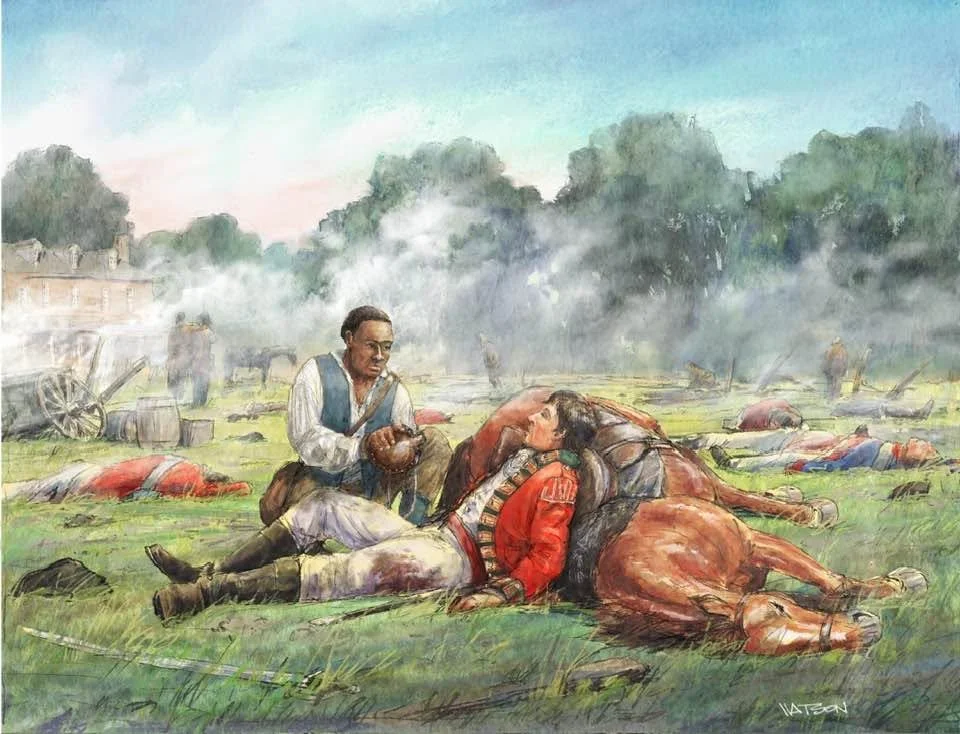
Lieutenant Fitzgerald and Tony Small by Dale Watson.
While it is unknown whether Small took part in any of the fighting at Eutaw Springs, he found the wounded Fitzgerald and helped him to safety. Small nursed him back to health and accepted a position as groom. Eventually, Small and Fitzgerald made it to Charleston, from whence they sailed to Ireland in 1782. Small would be Fitzgerald’s assistant and friend for the rest of his life.
Was Tony Small an enslaved person? His family is not listed among the approximately six hundred families in Paul Heinegg’s Free African Americans of North Carolina, Virginia, and South Carolina from the Colonial Period to About 1820. However, none of Lord Fitzgerald’s writings mention difficulty in removing Small from South Carolina or payments made to former enslavers. Very few records exist for Black people in colonial and Revolutionary South Carolina, so it is likely we will never know Small’s status before leaving the country.
A few years after the War, Fitzgerald and Small returned to North America and traveled together for eighteen months. They crossed Canada from New Brunswick to lower Ontario, where they then crossed into Detroit and made their way to the Mississippi River and down to New Orleans. From there, they returned to the British Isles. On this trip, it appears that Fitzgerald solidified his belief in equality and unity. In a letter, Fitzgerald writes: “I was going to send Tony to London to learn to dress hair, but when he was to go, I found I could not do without his friendly face to look at and one that I found to love me a little.” Upon their return, Fitzgerald began truly embracing the cause of Irish Unification.
The Fitzgeralds had residences in both Ireland and England. Small frequently stayed in Piccadilly, London, particularly after Fitzgerald’s death, though research is ongoing to learn more about his life while there. While in Ireland, Small married Julie, the nursemaid for the first Fitzgerald child. Tony and Julie had at least two children, Edward and Harriet.
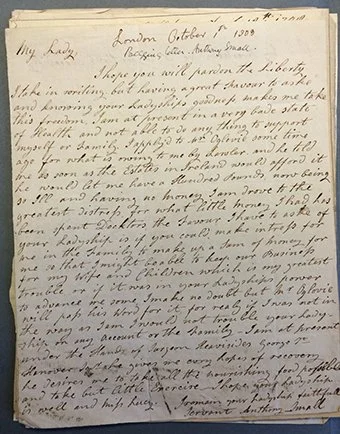
Letter from ‘Anthony Small’ requesting the payment of £100 owed to him from the Fitzgerald estate, 1803. National Library of Ireland.
Lord Fitzgerald died in 1798 at the age of 34, arrested and mortally wounded for his support of a unified Ireland. Immediately after his death, Small and his family helped Lady Fitzgerald and her children flee to Germany to escape creditors. Small stayed closely associated with the Fitzgerald family until at least 1800, and asked for owed money in 1803. (In the early years of their friendship, Fitzgerald had mentioned that Small wished to learn to read and write, though if Fitzgerald was involved in the instruction is unknown.)
The Small family battled illness and financial difficulty in 1803; Julie Small advertised her services as a lady’s maid, noting that she spoke three languages: English, French, and German. In 1804, the following record appears in the parish books for St. Mary’s Church, Wimbledon: "Anthony Small, a Black, aged 40, buried.” If this is Tony Small, he was one year younger than Fitzgerald and buried about 8 miles from his home. He may have been looking for work when he died. There is a record of a will for ‘Mr Anthony Small, a manservant of London’ in the Dublin Prerogative Court Index, but no will exists, possibly a casualty of the 1922 fire at the Public Records Office.
The two Small children lived to have children of their own, but only Edward’s line continued after one generation. Many of Tony’s descendants live in New Zealand, where his granddaughter immigrated.