Today, a visitor asked, "When did they add the 'c' to Moncks Corner?" and we thought that would be a good blog post!
The short answer is that it was always there. The longer answer involves spelling standardization (whether people included the 'c' or not when writing about the town). But neither answer includes the monks at Mepkin Abbey, who arrived over 200 years after the town was first settled.
The area around modern Moncks Corner was historically occupied by Indigenous peoples. During the late 17th century, the first permanent white settlers were largely French Huguenots, many descendants of whom still live in the area. These Huguenots intermarried with English settlers.
In 1735, James Le Bas - grandson of a French Huguenot immigrant - deeded 1,000 acres of land to Thomas Monck. Thomas Monck was married to Joanna Broughton, daughter of future lieutenant governor Thomas Broughton; it’s possible he purchased the Le Bas land to be close to his wife’s family, who had land in the area. Monck named the land “Mitton.”

By 1748, a settlement had sprung up in the area of Mitton Plantation and was called Monck’s Corner, as seen in this South-Carolina Gazette real estate notice. This settlement was likely called “Monck’s Corner” because it was on or near the land owned by the Monck family. Mitton Plantation was near the fork or “corner” in the road out of Charleston; the left fork went toward the Cherokee Path and the Congaree River Road, while the right fork went toward the Santee River and Georgetown and points northeast. Moncks Corner doesn’t appear to have been planned - it just happened to spring up around the heavily-trafficked intersection.
It is unknown who the first permanent residents of “Monck’s Corner” were, though they were likely traders or those who benefited from trade. The first known marriage in Moncks Corner was solemnized in 1754 between Simeon Theus of the town and Elizabeth Mackey of Amelia Township (near Orangeburg). By the late 1750s, several stores and businesses were located in the town.
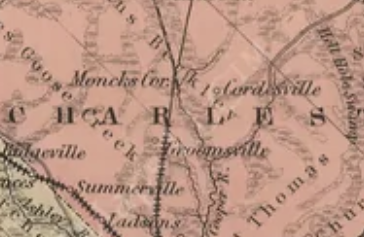
The apostrophe in the name came and went for decades, before (mostly) disappearing with the arrival of the railroad in the 1850s, as shown on this 1857 atlas. There was likely no postmaster in Moncks Corner between the end of the Civil War and 1873, when a post office was reestablished.
So where do the monks come in? In 1949, Henry and Clare Booth Luce donated a large part of the Mepkin Plantation property to the Order of the Cistercians of Strict Observance, more commonly known as “Trappists.” The Abbey is open most days and is a beautiful and historic place to visit.